












Choosing a Lifting Trolley for a Production Line

A lifting trolley can make production safer, smoother and easier to scale, but only if it fits the real handling task. The right choice depends on more than load weight. You also need to understand how the load is picked up, where it must be placed, how much space surrounds the machine, which production environment the trolley will operate in and who will use the equipment every day.
In a production line, a lifting trolley is not just a mobile lift. It becomes part of the handling process. If the trolley cannot approach the machine, reach the placement point or use the correct lifting tool, even a model with the right capacity can slow down the workflow.
For demanding production-line applications, the Lift&Drive PRX series is usually the starting point. It offers the broadest choice of capacities, chassis dimensions, columns, batteries and lifting tools. For lighter, simpler or especially space-constrained tasks, Lift&Drive ECO or Lift&Drive IE may be the better fit.
“The best lifting trolley is not simply the one that can lift the load. It is the one that fits the full production cycle: pickup, movement, positioning, transfer and release.”
Explore the Lift&Drive PRX series or explore all lifting trolleys.
Start with the handling task, not the trolley
A lifting trolley should be selected around the full handling cycle. That means looking at how the load is picked up, lifted, transported, positioned, transferred and released. Lift&Drive solutions can be used for many types of production handling, including boxes, crates, barrels, drums, rolls, tools, components and finished products.
The practical details matter. Where is the load picked up? How is it supported, gripped or secured? How far does it travel? How high, low or deep into a machine must it go? Does it need to be transferred, tilted or rotated? And what must the operator still do manually during the process?
These questions often reveal the real selection criteria. A trolley that can lift the required weight may still be unsuitable if it cannot reach the placement point, fit around the machine guards or use the right lifting tool for the product.
Quick answer: which Lift&Drive range should you start with?
The table below gives a practical starting point. It should not replace an application assessment, but it can help narrow the choice before you configure the trolley, tool and accessories in more detail.
If your application requires | Start by considering | Why |
Light loads, simple lifting and very tight spaces | Lift&Drive 70E or Lift&Drive 90E | Compact models for loads up to 70 or 90 kg. |
Up to 90 kg with a more stable industrial chassis | Lift&Drive 90IE | Wider and longer chassis than ECO. |
Machine feeding, tailored access, specialised tools or higher capacities | Lift&Drive PRX | Configurable platform from 90 kg to 325 kg. |
Roll gripping, rotation or vertical-to-horizontal transfer | PRX with the right tool | Supports tools including Squeeze&Turn and Expand&Turn. |
Hygienic, cleanable or corrosion-sensitive production | Stainless-steel trolley configuration | Relevant for food, pharmaceutical and cleanroom environments. |
Static-sensitive components or reels | Lifting-trolley accessories | ESD options can support static-sensitive handling. |
Pronomic’s trolley portfolio includes compact ECO models, the mid-range IE model and the stronger, more flexible PRX range for demanding industrial applications.
The six decisions that determine the right trolley
The right trolley is normally determined by a combination of load, tool, height, access, movement and environment. If one of these factors is missed, the final solution may become less efficient than expected.
Start by identifying exactly what is being lifted. Maximum weight is important, but so are the product dimensions, centre of gravity, pickup orientation, surface sensitivity and whether the product must be supported, gripped, turned or tilted.
Then calculate the total lifted weight. This includes the product, the lifting tool, any fixtures, packaging and a practical operating margin. The attachment is part of the lifted system, and it affects the configuration.
Height is the next important factor. Measure the pickup height, placement height, machine-shaft height, conveyor height, doorway restrictions and the geometry of the lifting tool. A trolley must work across the full movement, not only at the starting point.
Machine access is often where production-line applications become more complex. Check clearance below the machine, space around pallets, required reach, aisle width, turning radius, thresholds and operator walking space. A trolley that cannot approach safely will not solve the task.
Finally, define the movement and the environment. Some applications need vertical lifting only, while others require transfer, rotation, tilting or vertical-to-horizontal turning. Cleaning requirements, moisture, chemicals, hygiene, dust, ESD sensitivity, floor condition and number of shifts all influence the final trolley configuration.
Lift&Drive ECO: compact lifting for light, simple tasks
The ECO range includes Lift&Drive 70E and Lift&Drive 90E. It is the compact choice for applications where manoeuvrability, low trolley weight and easy storage are priorities.
Specification | 70E | 90E |
Maximum load capacity | 70 kg | 90 kg |
Minimum trolley weight | 31 kg | 31 kg |
Height range | 1,443–2,193 mm | 1,443–2,193 mm |
Length | 734 mm | 734 mm |
Width | 435 mm | 435 mm |
Maximum lift speed | 83 mm/s | 83 mm/s |
Choose ECO when the complete lifted system is within 70 or 90 kg, when the work area is narrow or congested, and when the task uses a simple platform, prong, fork or V-block. It is often suitable for lighter workstation replenishment, compact handling tasks and simple positioning where storage space is limited.
Typical production applications include supplying light boxes or trays to workstations, raising bins to ergonomic working height, handling smaller rolls with a V-block, moving tools and components between nearby stations and replenishing packaging materials in compact spaces.
Lift&Drive IE: stable 90 kg handling for industrial tasks
Lift&Drive 90IE has a wider and longer chassis than the ECO range. This provides increased stability while retaining a 90 kg capacity, making it useful for industrial tasks that are straightforward but require a more robust platform than the most compact ECO models.
Specification | 90IE |
Maximum load capacity | 90 kg |
Minimum trolley weight | 33 kg |
Height range | 1,687–2,182 mm |
Length | 771 mm |
Width | 555 mm |
Choose IE when you need up to 90 kg capacity, but stability matters more than minimum trolley width. It is suitable for industrial but relatively straightforward applications, such as maintenance, logistics or production support.
Typical applications include handling components at assembly stations, industrial maintenance tasks, moving crates, fixtures or medium-size parts, and small-roll handling where vertical-to-horizontal turning is required.
Lift&Drive PRX: the production-line platform
For demanding production-line applications, Lift&Drive PRX should normally be the starting point. It provides the broadest range of capacities and the greatest flexibility for chassis, columns, batteries, tools and accessories.
The PRX range offers 90 kg, 130 kg, 175 kg, 225 kg and 325 kg capacities, with electric lifting and optional lithium-ion batteries. This makes it suitable for production-line tasks involving machine access, specialised tools, repeated operation, heavier loads or future flexibility.
Specification | 90PRX | 130PRX | 175PRX | 225PRX | 325PRX |
Maximum capacity | 90 kg | 130 kg | 175 kg | 225 kg | 325 kg |
Minimum weight | 44 kg | 48 kg | 62 kg | 65 kg | 102 kg |
Height | 1,672–2,232 mm | 1,672–2,732 mm | 1,947–3,000 mm | 1,947–3,000 mm | 1,950–2,950 mm |
Maximum lift speed | 83 mm/s | 132 mm/s | 78 mm/s | 65 mm/s | 65 mm/s |
These figures are base trolley specifications. The permitted configuration depends on the selected tool, the actual load position and the application assessment.
Choose 90PRX when 90 kg is sufficient but the application needs more configuration freedom than ECO or IE.
Choose 130PRX for medium-load production work where lift speed, flexibility and manageable trolley weight matter.
Choose 175PRX when the product, tool or load position requires a stronger industrial platform.
Choose 225PRX when the process requires a larger handling tool, increased stability or heavier industrial loads.
Choose 325PRX for the heaviest Lift&Drive applications, especially when product and attachment weight require maximum capacity.
Explore the PRX series or configure in ProBLDR.
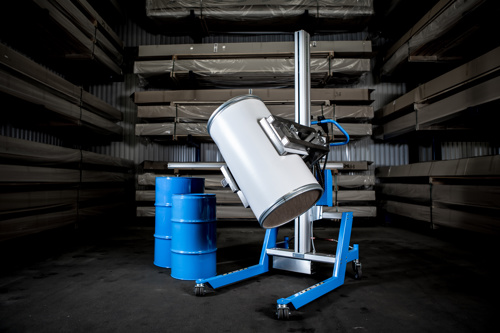
Choose the right lifting tool
The lifting tool determines how the trolley interacts with the product. For many applications, it is the most important selection decision after capacity.
Application | Tool to consider | Learn more |
Boxes, totes and stable components | Platform | |
Product transfer to equipment | Roller or roll-on platform | |
Roll with a hollow core | Prong | |
Roll requiring external grip and 360° rotation | Squeeze&Turn | |
Roll requiring vertical-to-horizontal transfer | Expand&Turn | |
Unusual product geometry | Custom tool |
Use a platform when the load has a stable base and can be supported from below. Consider a roller platform where the product needs to be transferred onto a conveyor, machine bed or work surface. Prongs are a simple solution for rolls already lying horizontally, while forks support rolls or products from below when the core must remain unobstructed.
Expand&Turn grips the roll internally through the core and supports vertical-to-horizontal turning for placement onto a machine shaft or other equipment. Squeeze&Turn grips the roll from the outside, keeping the core accessible, and can be configured for different roll sizes.
Choose painted steel, stainless steel or ESD options
The production environment affects material choice and accessories. A trolley used in a dry workshop does not have the same requirements as one used in food production, pharmaceutical production, cleanrooms or electronics handling.
Environment | Recommended direction | Learn more |
Dry workshop, warehouse or general industrial environment | Painted steel | |
Food, pharmaceutical or cleanroom environment | Stainless steel | |
Electronics or static-sensitive component handling | Suitable trolley with ESD options |
Painted steel is a versatile option for dry indoor industrial environments. Stainless steel is relevant where hygiene, durability and cleanability are critical. For electronics production, consider ESD options.
Configure the trolley around your production line
PRX enables configuration across six main areas: capacity, cross-member width, leg length and wheels, column, battery and tool. Each area affects how the trolley performs in the real production environment.
Configuration area | What it affects |
Capacity | Safe handling of the product, tool and operating margin. |
Cross-member width | Ability to move around pallets, equipment and obstructions. |
Leg length and wheels | Stability, machine access and floor clearance. |
Column | Lift height, travel height and reach. |
Battery | Duty cycle, charging routine and operating time. |
Tool | How the product is picked up, moved and placed. |
Battery selection should match how the trolley is actually used. Consider how many lifts are performed each hour, how many shifts will use the trolley, when charging can take place and whether a spare battery is needed.
Use ProBLDR to configure the right solution
Once the application is defined, ProBLDR can support a structured configuration and quotation process. It helps visualise the lifting solution during the sales and design discussion and is intended to support fast, precise and high-quality offers.
A typical configuration discussion starts with three questions: what do you want to lift, how heavy is it and what lifting height is required? From there, a Pronomic representative or authorised partner can work through trolley model, chassis, column, battery, tool and accessories to build a proposed solution.
Before requesting a proposal
A better first discussion leads to a better trolley recommendation. Before requesting a proposal, gather information about the product, the production environment and the movement required.
Information needed | Example |
Product type | Roll, crate, drum, box, tool or component. |
Maximum product weight | Include the heaviest product variant. |
Product dimensions | Diameter, width, length, height and depth. |
Pickup and placement condition | Floor, pallet, rack, machine, shaft, bench or conveyor. |
Required movement | Lift, transport, transfer, rotate or tilt. |
Machine access | Clearances, guards, leg access and doorway width. |
Environment and usage level | Dry, hygienic, chemical, ESD or cleanroom, plus lifts per hour and shifts. |
Photos or drawings are especially useful for custom tools or when the trolley must interact with a machine, shaft, conveyor or restricted access area.
Find the right Lift&Drive solution
For a simple, light-duty handling task, explore Lift&Drive 70E or Lift&Drive 90E. For stable industrial handling up to 90 kg, explore Lift&Drive 90IE. For most production-line applications involving machine access, specialised tools, repeated operation, heavier loads or future flexibility, start with the Lift&Drive PRX series.
Explore the PRX series, explore all lifting trolleys or start a configuration in ProBLDR.


