








Manual Handling and Compliance Across Europe

Across every market where Pronomic operates, the underlying principle is the same: the employer must avoid hazardous manual handling so far as is reasonably practicable. Where manual handling cannot be avoided, the risks must be assessed, prevented and reduced.
The common foundation is the European Manual Handling Directive 90/269/EEC, adopted under the Framework Directive 89/391/EEC. It requires the employer to take appropriate organisational measures, or to use appropriate means — in particular mechanical equipment — to avoid the need for manual handling of loads by workers. Binding law is then set nationally, and this is where the practical differences appear.
Those differences matter more than they might seem. Some countries set numerical weight limits in law; others deliberately do not, requiring an assessment method instead. A company operating across several markets cannot apply a single figure everywhere and assume it is compliant.
What the law says, country by country
Sweden
The overarching duty sits in the Work Environment Act (Arbetsmiljölagen 1977:1160). The binding provisions on manual handling and ergonomic load are found in AFS 2023:10, chapter 6 (belastningsergonomi), which has applied since 1 January 2025 and replaces the former AFS 2012:2 — a point worth checking in any older documentation, which frequently still cites the retired regulation. The Swedish Work Environment Authority also publishes practical guidance on manual handling. No fixed statutory weight limit applies; the duty is to assess and reduce risk.
Germany
Manual handling is governed by the Lastenhandhabungsverordnung (LasthandhabV), which implements the European directive alongside the Occupational Safety and Health Act (ArbSchG). Germany sets no fixed weight limits. Instead, the employer must assess the risk, and the recognised method is the Leitmerkmalmethode (key indicator method) published by BAuA, which scores posture, duration, load and working conditions together rather than judging weight in isolation.
Finland
The framework duty is set by the Occupational Safety and Health Act (Työturvallisuuslaki 738/2002), with detailed requirements in the Government Decision on manual lifting and moving (1409/1993). It mirrors the European duty closely: the employer must provide mechanical aids where lifting cannot be avoided. Practical guidance is published by the occupational safety and health administration at tyosuojelu.fi. No fixed statutory weight limit applies.
Spain
Spain implements the directive through Real Decreto 487/1997, on minimum health and safety requirements for the manual handling of loads presenting risks, particularly to the back. It notably repealed the old blanket prohibition on carrying loads above 80 kg, replacing a single legal ceiling with a risk-assessment duty. The INSST publishes the official technical guide, which sets out reference values for maximum loads together with correction factors for the individual, the load and the frequency of handling. These are reference values for assessment, not statutory limits.
Netherlands
The Working Conditions Act (Arbowet) is a framework law; the operative rules on physical load sit in chapter 5 of the Working Conditions Decree (Arbobesluit). Article 5.2 requires that work be organised, the workplace arranged, and production methods or aids used in such a way that physical load cannot endanger the safety and health of the worker — an explicit duty to reach for equipment rather than muscle. There is no statutory weight limit; assessment tools are published via Arboportaal and enforcement sits with the Netherlands Labour Authority.
France
France is the outlier, and the exception that catches multinational employers out. The Labour Code, articles R.4541-1 to R.4541-10, requires the employer to provide mechanical aids (aides mécaniques) where manual handling cannot be avoided — and, unlike its neighbours, sets actual figures: 55 kg for habitual carrying, up to a maximum of 105 kg subject to a medical fitness assessment, and 25 kg for women. Prevention guidance is published by INRS.
United Kingdom
The Manual Handling Operations Regulations 1992 (as amended) sit under the Health and Safety at Work etc. Act 1974. The duty follows a clear order: avoid hazardous manual handling where reasonably practicable, assess what remains, and reduce the risk. HSE guidance publishes indicative guideline weights, but these are filter values to help prioritise assessment — they are explicitly not legal limits, and a load below them is not automatically safe.
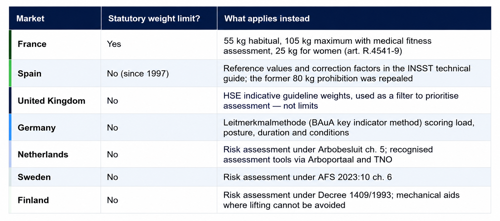
Weight limits: the difference at a glance
The single most common cross-border mistake is assuming one country’s number applies elsewhere. It does not.
Assessing the risk
Whichever market you operate in, the assessment considers the same four dimensions.
The task should be assessed on whether it involves twisting, bending, stretching, repetition or long carrying distances.
The individual concerns the people doing the work — their physical capacity, training, experience and any health considerations.
The load must be judged on weight, size, shape, stability and how easy it is to grip and handle.
The environment covers floors, space, lighting, temperature, working postures and other constraints in the workplace.
The hierarchy of control
Good practice addresses risk in a clear order. First, establish whether the manual handling can be eliminated altogether. If it cannot, the work should be mechanised, assisted or reorganised so that the load on the body is reduced. Only then should you rely on instructions, safe working methods and training.
Lifting equipment belongs to the middle step of that hierarchy. It is the practical measure when a task cannot be designed out, but where the physical load can be reduced with the right equipment — and it is the step that several of the national regulations point to explicitly, from the French requirement for aides mécaniques to the Dutch duty to use aids so that physical load presents no danger.
What good compliance looks like
Good compliance means the employer works systematically to identify, assess and reduce the risks of manual handling. In practice that includes:
Documented risk assessments that are kept current.
Training for the people carrying out the work.
Suitable equipment provided and maintained where tasks cannot be eliminated.
Regular review, particularly when workflows, production lines, materials, loads or the working environment change.
For multi-site operations: the national reference applied per site, not one group-wide figure.
Where equipment comes in
When a task cannot be eliminated, the right lifting aid is often the most effective practical measure. By choosing equipment matched to the load, the working environment and the user, the employer reduces the risk of musculoskeletal injury while creating a safer and more efficient workflow.
Pronomic’s range covers a broad spectrum of lifting and handling needs across many different industries. With the right solution, companies can reduce physical strain, improve ergonomics and strengthen compliance with applicable work environment requirements.
Frequently asked questions
What do the manual handling regulations require?
In short, they require the employer to avoid hazardous manual handling where reasonably practicable. Where it cannot be avoided, the risks must be assessed and reduced. The binding rules are national — for example AFS 2023:10 chapter 6 in Sweden, the LasthandhabV in Germany, and the Manual Handling Operations Regulations 1992 in the United Kingdom.
Is there a legal maximum weight one person may lift?
It depends on the country. France sets figures in law: 55 kg for habitual carrying, 105 kg maximum with a medical fitness assessment, and 25 kg for women. Most other European countries — including Sweden, Germany, Finland, Spain, the Netherlands and the United Kingdom — set no statutory limit and require a risk assessment instead. Published guideline or reference weights are aids to assessment, not thresholds of legality.
Do the same rules apply across all our European sites?
The underlying European duty is common, but the national implementations differ in ways that affect practice — particularly on weight limits and the prescribed assessment method. Apply the national reference for each site rather than a single group-wide figure.
Must all manual handling be eliminated?
No. The requirement is not that all manual handling disappears, but that risks are reduced so far as is reasonably practicable. Where a task cannot be designed out, the employer reduces risk by providing suitable lifting aids, training and safe working methods.


